Category: Life Experience (Page 2 of 2)

A Heuer Autavia Tour of the 1970s

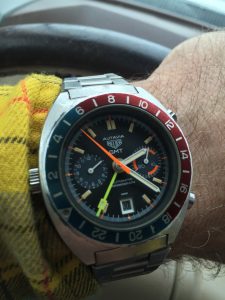
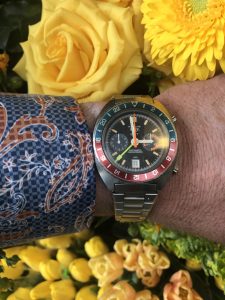
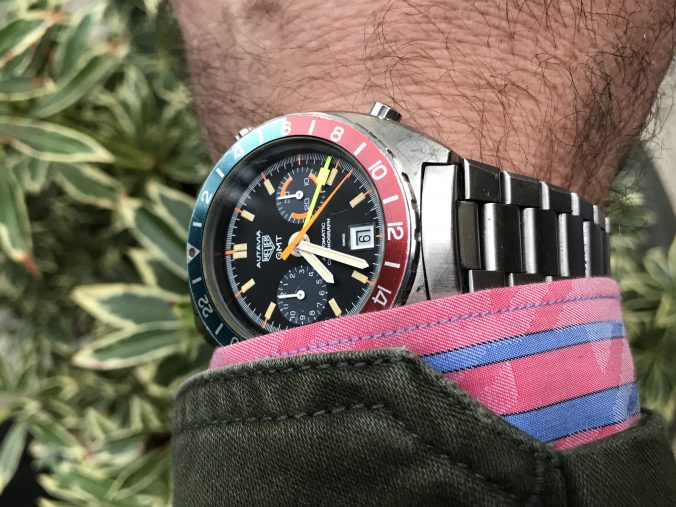
When my eyes scan down to check the time on this Heuer Autavia GMT Chronograph, I think of Jimi Hendrix with a choke-hold on his ax, wearing a  psychedelic, multicolored military jacket.  He is standing on stage operating his stringed instrument powered by an amplifier as if he just landed here from another galaxy and needed to employ it for communication.  Right at the same moment, a candy-apple red GTO tears up a side street.   The planetarium fixes its lunar star lights onto a stage back in time.  I hear a screech and the whip of sweat-riddled hair from Janis Joplin while catching a visual of your father’s comically wide orange and harvest gold tie.  Radioactive yellow reaches out from the watch’s phosphorescent dial alerting everyone that neon had no curfew in the 1970s.

A certain charge and mystique take possession of this watch filling it with inspiration the day it was born.   The manufacturers made sure they created a misfit that would not hold up in today’s technological jungles of preordained obsolescence.  Newly engineered in 1973 with an automatic chronograph movement, the Calibre 11, it ticks along with a spare time-zone to boot.   The Heuer 11063 is an amalgamation of all things 1970s.  Colors do not pretend to blend and match, a clash of red and orange suggests space and tolerance for what does not fit preconceived notions.  A rebellious air vibrantly decorates and mutates its aura making it a true and honest emblem of an era.  Going back in time you can drum up any number of side-kicks from this disposable era that left little for posterity,  with its lack of visual recordings.  Analogue was all there was, along with paper and manual knobs on the TV and rotary phones.   A time where litter and pollution were part of every big city and no one cared least of all the street cleaner who scattered the street debris onto your lawn.   Instead of wearing a seat belt you fought to see how many teenagers could fit into a VW Beatle and still drive or you stuffed stooges into phone booths for a laugh, now on occasion you see a broken down phone booth among the detritus piled up after the wrecking ball swings.

This is the beauty of unleashing memories attached to the era when this watch came into being.  Heuer was one of the competitors who partnered alongside Hamilton, Breitling and Dubois Depraz, all of whom collectively designed a movement that raced against inventions put forth by Zenith and Seiko for the honor of being the first automatically wound chronograph.  The watch discussed here is a couple of generations newer and includes a GMT complication but it remains a close relative when it comes down to the brass tacks of the original automatic chronograph.  Up until 1969 there were many automatic watches in existence, pieces that underwent self-winding during the natural movements of the wearer, but all chronographs had to be manually wound.  There is quite a bit of interest,  among collectors, that focuses on the steel sports chronograph models of the mid-late 1960s, just before the automatic chronograph was born,  and the early 1970s when there was a flurry of production aimed at the automatic chronograph.  I also devote a significant portion of my collection to both manual wind and automatic chronograph watches manufactured during this fascinating period in vintage watch history


This Heuer Autavia GMT Chronograph knows there were no computers when it was born.   Its winding crown is on one side and chronograph pushers on the other side.  The dial is a matte dark slate-gray, neutral like a tabula rasa for all the colors and design flourishes to be added.  There are six hands in total, each with a specific assignment as the dial is balanced with a rectangular date window at 6 o’clock and two chronograph sub dials at 3 and 9 o’clock, the minute and hour totalizers respectively.  There is a colorful, driven, urgency to this watch and it stands proudly on the wrist with a diameter of 42 mm and width of 14 mm, more reminiscent of a watch that Stallone would wear in the early 2000s.  Size and stance aside, there is no doubt this is a product of the 1970s and it can easily serve as an honest representation of 1970s style and sensibility in general.

The fact is, this watch on my wrist makes me happy.  Digressions mix with dreams  and brightly photographed magazine displays to embellish the parade that was out there when this watch came into being.  Jim Morrison’s lizard skin shirt, black leather pants and chelsea boots were on album covers and magazines but when photographed by the omnipresent Andy Warhol ,wearing albino glasses, the gentle descriptions of freedom came true.  Warhol with his Cartier Tank once directed an 8 hour film called “Sleep, ” about a man doing nothing but sleeping. Such was the tail end of the 1960s and early 1070s, for some a giant snooze-burger, for others the only real, honest life lived in the 20th century  .    Propriety got out the way to usher in renegades of individuality and the terminally unique.  Those high on the idiosyncratic scale flourished because all the cross-currents and juxtapositions found their soul-mates of style and came out of the closet to accept incongruity.  Incongruity is funny and it makes you think and just when you realize two things don’t belong together two decades go by and you can’t imagine peanut butter without chocolate.  That’s why I like the Heuer Autavia 11063 GMT Chronograph.  It’ too big and thick on the wrist,  it’s for pilots but not discrete enough for pilots, it is loud and colorful like an Italian race car driver from Milan but it doesn’t have the delicacy of a Paul Newman Daytona.  It hijacks the pepsi bezel from Rolex then it outdoes that color scheme with florescent yellow and orange that seem to belong on a different watch altogether.

I can’t help  but reminisce  here.  The electric kaleidoscopic dance-step shock-waves course into my bloodstream pulling worlds together in the moment, finding the juice to hail back into another time that feels like yesterday’s child, sneaking away to crash his first concert ever at the “Garden,”  with the rest of the teenage misfits jut trying to fit in. That was a night.  Flying high on qualudes and malt liquor, the mescaline just kicking in as the “Village People” take the stage.  Boys wanting to imbibe all of life at once and graduate into the realm of cool that very instant, against strict parental orders, away from all  corridors of safety, oblivious to the dangers raining down.  There was security in numbers.  Ideas hatched from the forbidden zone, coaxed into place and made OK by the gyrations of teenage rationalization born among and between all involved without thinking of permission because forgiveness never failed to save them.

Then another story comes to mind. You catch an opening as the subway doors part and there he is again blind with the tin coffee cup rattling change scaring the children with eyes burned shut like a mad surgeon closed off his world for fun so that now all he does is repeat Jesus over and over opening sliding doors between subway cars and when we all hear the rapid gust followed by the door slamming it is clear another angel survived a terrific hailstorm of progress only too happy not to see where the world is going.


Then a boy leans over and asks his father next to him why he feels scared when the blind beggar walks by.  All the clamor, unsteady footing and peculiar facial expressions instill fear inside the claustrophobic subway car, while all others look down or away and into newspapers while the boy’s eyes never leave the poor man,  transfixed and enveloped by a miasma of gestures performed by the blind man, dramatic act or unconscious vestiges caught in a reflexive arc removed from the voluntary arsenal of movements, deliberate or beyond his control? It makes no difference.   A part of the boy  believes maybe the man can see and he will notice the stares and spring toward him suddenly and without restraint allowing all the pent-up troubles to bubble over.

The father’s arm wraps around the boy’s shoulders and a prayer settles over them both.  The father fears nothing and the boy feels this as he nestles into the embrace.  They are going to the opera,  the Metropolitan opera to see “Rigoletto,” with the great baritone Placido Domingo in the lead.  The subway offers a real dose of life on the way to an escape from the world, into the red crushed velvet curtains and tuxedos surrounding jeweled women elegantly shuffling in heels on the arms of masculine gentlemen sipping fine spirits on the balcony.  On the way they pass street walkers and peep-shows and three-card Monte confidence men all with a smell of rotting fish stale beer and cigarette smoke that mixes with the steam coming out of the grates. Then suddenly there are the stairs and the columns leading up and into a sophisticated parlor of elegance with hors d’oeuvres and mink stoles.

It is almost 8 PM and they enter the auditorium and take their seats.  The boy skims the program.  He does not know the story so his father provides him with the Cliff-Notes summary.  The boy knows they will go to Katz’s delicatessen afterwards for pastrami sandwiches and chips with a giant dill pickle from the barrel.   The boy wishes the opera would just hurry up and be over.  The great auditorium darkens and spot lights expose the stage.  There are no empty seats.  The boy surveys his environment as the father leans back, with fingers interlocked on his abdomen drinking in the sounds he loves so much. Placido Domingo walks on stage and the show begins…


Crown Guard Love

I first saw a Panerai watch on an airplane returning to Portland from an Orthopedic Surgery conference in Chicago during the winter of 1996.   Panerai watches were rare among civilians having been used strictly by the Italian military during the 1930s, 40s, and 50s. They were not sold to the general population at all until the mid 1990s. A well-dressed, handsome, European man was stretching his legs in the aisle and reaching for something in his bag stored in the overhead compartment.


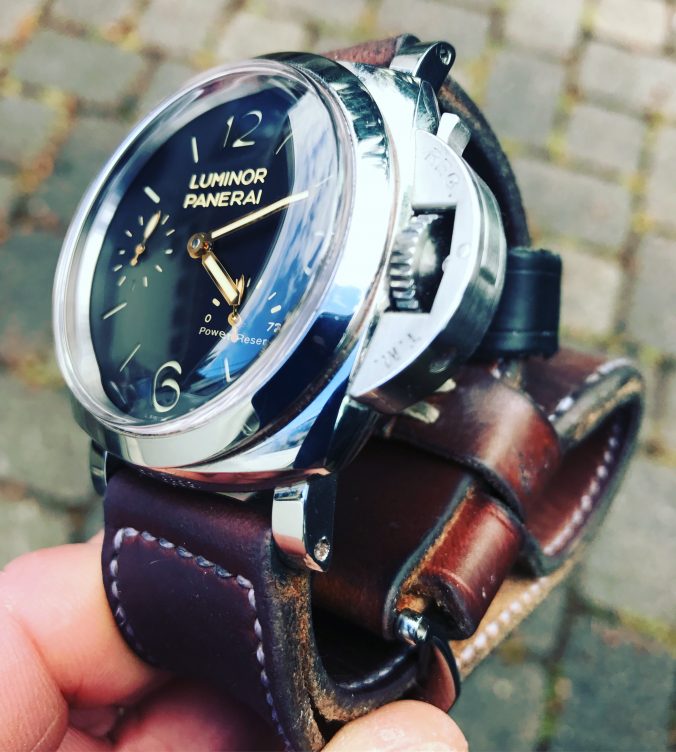
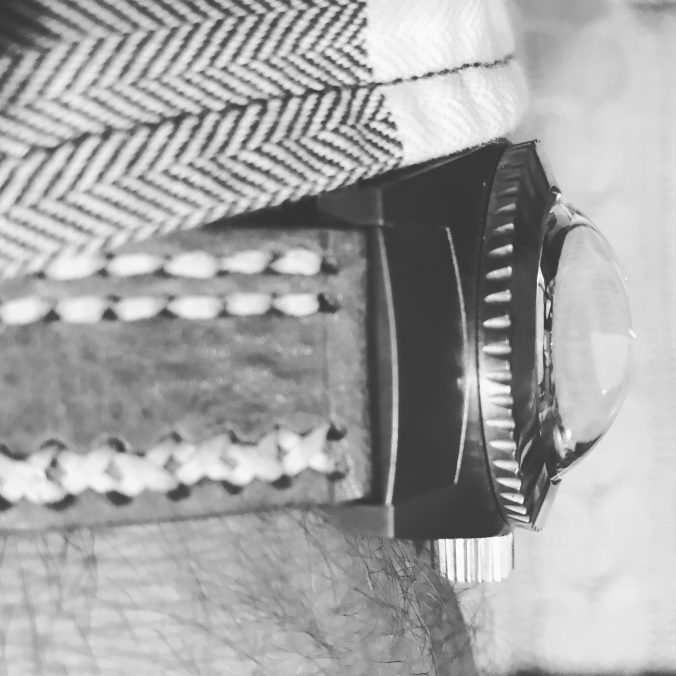
I caught sight of his left wrist. A soft-blue dress-shirt with the cuff rolled up revealed an utterly unique watch. Suddenly and with a declarative power of it being the only entity, at that moment, worth looking at, the Panerai hove into view. There was an immediate sense that this was unlike any previous watch that had entered my visual field. All else blurred into the background as my eyes lit on the rounded curves and angles of this gleaming tool from another era. My intellectual powers were relinquished under the spell of this object. Emotions within me kept peering out towards what looked like the strong curves of a woman in a military stance guarding a hidden gem beneath the crystal.   A rich chocolate brown leather strap with white contrast stitching, in oiled distress, secured the watch to his wrist. It was large but not overly so. Proud to sit exposed yet obscured in its artistry,  it was akin to an armored car in a dream by Picasso. There was a glorious presence to this piece. It sat slightly off-center on the wrist as he gripped his garment bag and reached in its pocket for a book.


Sitting across the aisle on the left of this passenger allowed me to hone in on the watch as he held his book reading. He was silently mouthing the “elegies” by Rilke in German.   On his wrist, I could feel the natural Florentine flourishes bold and novel with no regard for subtlety taken over by Swiss intricacies internally and maybe polished up by the muscularity of an over-engineered German sensibility. The last part was an incorrect guess on my part, but it could have been, only it would be tighter with sharper angles. It was enough that the glowing lantern was born in Florence in a small workshop run by Giuseppe mining the possibilities for underwater illumination needed by the Italian navy frogmen.   Radioactive paints coating large discs formed the base-plate over which a stenciled dial was laid allowing the torch-light illumination to shoot through the slits and crevices emblazoning underwater endeavors and sneak attacks. It now only required the Swiss movements within, a time-telling apparatus to move the hands of fate across the wide screen of the dial.


Having looked at and studied innumerable timepieces in my life, I have a specific taste in a sports watch and this was not it. It was not that this was not it, rather, it was that the it of my timepiece desires had not entered my awareness, therefore I had no idea yet what the it was to me. This timepiece hit me like an uppercut with a chaser of smelling salts. There was a specific quality that jumped out at me that I had not conceived of and this was followed by an overriding attraction that quickly enveloped me. I was reminded of castles with geometric turrets and clandestine drawbridges bypassing treacherous moats. There were control-levers and knight’s armor with crossed swords and monogrammed shields clashing with the scrape of steel on stone and the polished severing of human tissues in silence. I reverted to dreams of artillery shells raining onto bivouacs hidden inland under glacial palms.

This started as an almost obsessive fixation on the crown guard. Obsession is desire unhinged from reason. This can be rather unpleasant, or the obsession can lead to a sort of spiritual learning of the educational variety using a material object as a trajectory. With a watch, especially a vintage watch, the historical significance can generate a runner that encapsulates an era where vicarious transport takes one beyond the mere material appreciation of the object at hand. It was that type of experience, a feeling of being transformed, of having arrived in the presence of a watch whose entire package felt like home.


A heavy metallic outcropping adorned the crown-side of the case. It surrounded and enclosed the winding crown like a muscular steel extension of the body of the case with serious military aspirations. It spoke a new horological language to me. This crown-protector was full of bluster and serious attitude, artisanal in its soul, a proud tool for underwater battlefields stamped on its façade. The case itself had smooth, curvaceous shoulders and cushions as the lugs extended slightly downward forming itself to the wrist’s contours. It did not matter how I viewed this watch or from what angle my eyes came upon it, the crescent moon crown-guard drew me in with the intensity of a red-hot alloy being forged before my eyes. I imagined the curved arc of this brushed metal excrescence fluidly locking in the control point of the watch and then disengaging the lever to release the crown’s functions. As I allowed my eyes to climb up the medial aspect of the polished smooth bezel the sharp edge of the domed crystal became apparent as the periphery of the dial became distorted and slightly blurred by the fish-bowl effect of the sapphire. Again my attention was struck by the crescent steel guard proudly encasing the knurled edges of the movement control-wheel soundlessly shouting a masculine drum-beat, fortifying and barricading the only entrance for renegade fluids or particulate debris with designs on the internals of this manual-wind machine.


As my in-flight neighbor handed me the watch I was so obviously inspecting, and complemented me on my Omega Seamaster, I held this artfully created diving tool in my hands. It had a warm, charged, volcanic quality that started speaking to me in a novel lexicon of watches I had never experienced. The fierce attitude of the crown-guard leveled any strong feelings of minimalism in a dive watch I might have had, and awakened a shift in my desire towards a watch with an overt proclamation for its own existence and function. This was a trumpet-call, a sledgehammer crushing stereotypes and preconceived ideas of military timepieces designed for divers. I immediately became an Italian Frogman during WW II, immersed and directed towards a mission on my double-leg torpedo guided by the illumination of this firefly torch lighting up the depths.

As I now examined this Panerai watch, other qualities revealed themselves between surges of attention to the crown guard. There was the dial itself with a special simplicity to its Arabic indices at 12, 3 and 6 o’clock. Theses numerals and the stick-like indices for the remaining hours were cut outs in the dial with a yellowish substance showing through. The dial had stencil-like openings in the shape of hour indices to let another pattern show through. If I shined the light of my cell phone onto the dial it lit up brightly and glowed strongly. This was the luminor of its namesake inscribed on the top center of the dial.


The remainder of the dial had a power reserve indicator and a running seconds sub dial at 9 o’clock. Power reserve is a complication I find useful on a manual-wind watch. It serves to indicate if one needs to wind the watch soon. I do not see the need for a power reserve on an automatic timepiece yet one sees them frequently in this setting as well.

When I look at my watch I appreciate some indication that the watch is running. Many Panerai base models have no running seconds indicators and this offers a level of simple readability that I respect, but I still prefer to see the seconds tick by when I glance at the time.

After twenty minutes, I hand the watch back to my neighbor and give him kudos regarding his style.  My watches are projections of the various selves I have assembled in the closet of my being.   Childhood stories and memories form alloys with dreams and hooks of songs that recall scenes from films gelling together with overheard conversations  and passages from novels growing extensions in imaginative shapes all congregating and assembling into the decisions of who I am at a given moment, and all this plays with the fire for that unique melting pot displayed to the world at large and if that results in a gracious complement regarding my watch that day I return a thankful nod with friendly eye-contact.  The same applies to any  source of identification especially when it transcends cultural boundaries.   I indicate an acknowledgment that I too, respect Rilke’s work. He reapplies his Panerai to the wrist and I resume my book while sinking back into the music plying on my headphones. I close my eyes and fantasized about bygone eras. I imagined underwater missions, illuminated  views of submarines surrounded by sea-organs voicing their own songs of the time.


How a Vintage Watch Can Bring Back Forgotten Memories

My Vintage Jolus Watches and how these Relate to My Grandfather’s Private Artifacts and our Stealth Relationship


There is an otherworldly quality that certain objects manifest.  Something that transcends their mere purpose in the real world.  This is a quality that sits and hovers just above a young boy as he holds his grandfather’s cuff links, and wrist-watches, and even his ivory-handle shaving razor,  a  quality whose power etches primal memories onto the cave wall of the young boy’s hopes and dreams.  Later on, he remembers that those moments opened up and expanded his ability to drink-in important details that shaped his conception of style and beauty and as  these material possessions transformed into heirlooms, a serene cast of understanding filtered in reminding  him that, not the objects themselves, but the memories spawned from these treasures are where his gratitude lives on and shapes everything before him.

Oftentimes conversations,  physical environments, objects, or dreams, recall memories that seemed to have  been lost.  A wrist watch, for me, is great fodder for memory recall, and I think of  the experiences I have while looking at a watch, as it takes me back to memories from the past, as a form of time travel.  It may be my father’s actual watch, or a personal watch that reminds me of a time-piece from my childhood, that initiates these long-lost memories.  Another experience for me, is the act of examining a watch I am interested in buying or one I already own that is associated with a time period in history where it was used for a specific function. I imagine inhabiting this era in time and living the life of a military navy seal during wartime or a race car driver timing laps with his chronograph before computers came on the scene.  These tool-watches for divers, pilots, race car drivers and infantrymen have a great mystique attached to them and each scar on the case and scratch on the crystal tells a story.

As a physician who has studied his fair share of psychiatry over the years, I am fascinated by what my mind remembers and doesn’t remember.  It is interesting that a person’s moral structure is formed in grade school, yet memories from this period are scarce.  Many more memories are living and present in both the conscious and unconscious mind than I am aware of.  Psychiatrists and psychologists tinker with the idea of uncovering repressed memories in an attempt to shed light on why someone may have certain psychiatric illnesses.  I have read that some of these memories may be real and others fabricated.  In the setting that I am describing whether these recollections are entirely true or real is immaterial.  Even if only bits and pieces are actual experiences and the rest are from dreams or childhood mental extrapolations, this exercise continues to have a beautiful relevance as something that adds interesting dimensions to the sometimes hum-drum tedium of modern adult life.


I stumbled upon a pair of watches a few years ago while surfing on ebay.  I was curiously drawn to them and I felt a strong pull to examine them and ultimately purchase both of these watches, for reasons I did not understand at the time.  Once I received these pieces and had a chance to study them and wear them, I began to recall a watch that my grandfather owned when I was a child.  With time on my wrist, one of these watches in particular, was instrumental in helping me delve into memories that had not surfaced for some time.  I began to swim in these recollections and before long entire stretches of time became real and I was living them once again now with a clarity I didn’t believe possible.  I felt the leather of Pappa’s armchair, the smell of his pipe smoke,  the sun  flickering through the blinds draped over the windows of his Bay Ridge apartment, and the taste of the sweet rock candy he always kept nearby.

I searched my mother’s house for clues related to this dress watch my grandfather cherished.  There was no sign of it now, and I struggled to remember if this “Jolus” watch I now owned was of the same make and model as his watch.  What if the watch i now owned was his actual watch, given to a friend and subsequently sold.  My grandfather,  Ivar, was a generous man, a man who would give a friend his watch if he told Ivar how much he admired it.  Unlikely, of course, but this sent me on a course to find out what I could about the brand and in the process the memories that I bumped into on the way have become close and intimate friends that I will always cherish.  The  beauty of newfound memories is that I have seemingly experienced them once already and now with my mind layered with experience, mining these distant memories feels like becoming recharged with childhood sentiments that I had lost access to long ago.


There is not much history available regarding “Jolus” watches. Jolus (which may be the German word for the Greek god Aeolus) was a Swiss watch company associated with another Swiss watchmaking company called “Verdal.”   This is an obscure, relatively  useless fact that underscores the paucity of information out there regarding this watch brand.  These watches are rare (a term vastly overused in vintage watch circles but in this this case dead-on appropriate.)  I have been collecting watches a long time and the two that I own are the only ones I have ever seen for sale.  Safe to say,  Jolus was a casualty of the quartz crisis and I consider myself fortunate to have found a pair of time-pieces so close in resemblance to my grandfather’s dress watch, that I was stimulated to recall memories long dormant to me.

During the World War II era, when this time piece was made, there were hundreds of such Swiss companies. Jolus is believed to have made watches specifically for military indications.   It was imperative that soldiers have accurate means of recording and coordinating time for various combat activities.  This type of tool watch needed to be sturdy and tough.  The dial needed to be readable often with Arabic numerals and many military watches of this era were complicated by chronographs which served as separate stop-watches to independently time flights, military maneuvers, bombing distances and the like.

Interesting period-specific additions added to watches of this era designed to yield information important back then and not typically required or included on watches today are part of what make vintage watches interesting to study.  An era in history creates a need,  and watches, very often, answered that call,  by integrating complications that served as effective tools of the day. An example of just such a concept is a numerical index referred to as a telemeter scale.

The telemeter scale is a valuable mathematical measurement inscription usually on the outboard perimeter of the dial.   Sometimes it can be more central on the dial and is often depicted in red print.   It runs from the 12 o’clock position in kilometers ranging from zero to twenty. This scale is employed in conjunction with the associated chronograph, which is an independent stop-watch within the watch, controlled with the two square pushers at the 2 and 4 o’clock positions.  A soldier under mortar attack engages the chronograph as soon as he hears the launch of a mortar. He then stops the chronograph when the mortar lands and explodes. The numerical reading on the telemeter scale tells him precisely how far away the enemy firing the mortar is in kilometers.

Another curious fact  during this era is that Americans were not allowed to own gold bullion, so this Jolus watch, as were many watches during this time,  was encased in gold as a way of getting around this restriction.  This addresses the question of why a military watch would be constructed  out of 18 karat gold.   Most other watches made in the U.S. during this era were gold plated because of this restriction.

One way of generating some data on a watch were little is written and available is through providing some recent sales descriptions, not for cost, rather,  purely for further information gathering purposes.   would shed a little more light on what makes these watches unique or not.

An example was sold on Ebay in July 2008 with the following description:

“A rare and superb vintage watch with a gilt dial signed Jolus, outer telemetric and tachymetric scales, subsidiary constant seconds and minute recording dials, 17 jewel nickel-plated movement, metal curvette case with snap on back, diameter 37 mm.”

On 10/11/2013 at an Aniquorum auction in Hong Kong a Jolus time piece was sold with the following description:

“Jolus, pink gold, new old stock, Jolus case number 292535. Made in 1950’s. Fine antimagnetic 18K pink gold watch with square button chronograph tachometer (sic) and register.

“Three body, solid, polished and brushed, curved lugs: inclined bezel, soft iron gilt metal dial with antimagnetic lining, snap on case back, pink gold Arabic numerals, outer 1/5th second track with 5 minute/second Arabic markers, outer tachometer scale, subsidiary guilloche dials for running seconds and 30 minute register. Pink gild alpha hands Rhodium plated, straight-line lever escapement, monometallic balance, self-compensating flat balance spring index regulator. Case shape, round, 38 mm.”  This is the extent of the literature I could find during my research of Jolus watches.


After possessing the two watches discussed in this writing, I began to notice a flurry of memories from my childhood.   What is memory and what is embellishment remains a mystery.  This concept sits well with me and the power of a watch to generate both actual memories and fictions gives me great pleasure.    Before I relate this tale of my grandfather’s watches, and our relationship, I will convey what I see when I examine these beautiful vestiges from a bygone era.

The Jolus with the champagne dial, Roman Numeral indices at XII and VI o’clock receives more wrist time in my world. The dial itself started out life as a lighter gold color and with time has taken on a darkened patina that embodies it with the richness and character reminiscent of the subtle crows feet around the eyes and mouth of a woman’s face that betray her emotional and secret expressions. Markings of dignity and individuality that women strive to rid themselves of during misguided moments of vanity. It is such distinctions of maturity that separate those beautifully adorned with the majesty of time from those purely expressing the unseasoned canvas of youth.

In a timepiece, it would be sacrilege to replace or refurbish a dial cured and yellowed with the passage of time. Maintaining the original with all its imperfectly evolved blemishes is the gift collectors search the globe for. Though I have never seen a new example of this watch I am sure it possessed a lighter shade of gold that announced a naïve version of itself at birth.

The chronograph complication is my most desired addition to a watch’s basic ability to represent real time. The sub dial at nine o’clock measures the seconds in real time since the central second hand is designed to record time for the chronograph, which is a separate stop-watch. The sub dial at nine o’clock is a minute totalizer designed to tally up to 30 minutes for the chronograph. Both sub dials are artfully countersunk and are monotone to the dial but have darkened slightly more than the expanse of the dial. At the perimeter of the dial the telemetric scale pushes against the outer reaches and is printed in black while the minute scale is in-board of this and just outside of the hour indices.

The hands are heat-blued in a process where high temperatures are applied to the metallic hands until they reach a certain point turning them into a darkened hue of blue, a process that Cartier originated and perfected. A beautiful flourish is the open circle of the hour hand known as a pomme (apple) hand. The case is very elegant, in solid rose gold measuring a generous 38 mm, quite large for that era. The lugs curve gently downward and the width is quite thin, with the domed plexiglass crystal accounting for roughly two of the 11.5 mm thickness. The chronograph pushers are of the classic square design seen in the 1940’s and both the crown and snap on case back are unsigned, which is unfortunate.

The second example with the silver dial and sub dials of comparable size and dimension but the dial utilizes a completely different layout, coloring scheme, and design DNA. I enjoy the pop of red and blue used for the telemetric and tachymetric scales respectively. This piece covers its bases with both military speed measuring utility beneficial to soldiers, pilots and race car drivers alike.

The countersunk totalizer  sub dials are vertically oriented with the minute recorder for the chronograph at 12 and the running seconds positioned at 6 o’clock. The lance-style hands are gold as are the indices for the hours. The case is also solid rose gold and measure 37.5 by 12 mm with a similarly domed plastic crystal which gives the dial an added warmth and slight distortion that is charming compared to modern sapphire.


When I was seven or eight years old I spent a great deal of time with my maternal grandparents. My middle-namesake, Pappa Ivar, was a taciturn, powerful fisherman and iron worker from a village area on a group of small islands off the southeastern coast of Norway called Lyngor. It is a fascinating village located and spread among several islands (Odden, Lyngoya, Steinsoya, and Askeroya) grouped together and separated by straits no more than one hundred meters wide. Ivar grew up on boats and on the water, spending just about every day of his young life fishing before he emigrated to America in in 1924.

As a child I was intrigued by the treasure trove of artifacts my grandfather kept on the table next to his favorite burgundy leather chair and ottoman. I would sit near him and we might talk a little, mostly we sat in silence and I observed his movements, behaviors, moods, postures, interactions with my grandmother, as well as any gestures he displayed. He had a variety of delivery systems for tobacco. Ivar was prohibited, by the iron hand of my grandmother Constance, from smoking cigarettes, but if I was able to purloin one of my aunt Elsa’s cigarettes, he would give me the secret handshake and a wink of approval.

Next to his favorite chair were several tobacco pipes that had this wonderful smoky-wood-apple aroma that is part of my everlasting olfactory lexicon. He kept cans, pouches as well as squares of chewing tobacco and cigars of varying size and thickness. There was rock candy that looked like translucent chunks of crystal and diamond connected by string. I liked to lick these gems but I was sure if I tried to bite them I would splinter my teeth.

His wallet and leather change holder were underneath on the second shelf of his personal end table along with cuff links and writing instruments and two watches he interchanged depending on the day. Ivar was also prohibited from drinking and he relied on my sister and me to locate both cigarettes and cans of beer.   I quickly became adept at clandestine missions for Pappa Ivar and when I was with him, it became my job to sneak him a beer when he whispered the request in my ear. He would then walk out the side door and around the vegetable garden to the garage where he would enjoy a beer and a cigarette that I lifted for him. When he would disappear on one of these stealth refreshment breaks, I would climb into his warm broken-in chair and examine the contents of his private table.

My eyes would always return to the two watches on the bottom shelf. First I would pick up the steel Seiko on a bracelet with the silver dial and day-date complications. The crystal was massively scratched as was the case and bracelet. This watch seemed to be sized to fit a tree-trunk wrist, a description that was not far from the truth. Pappa was in his seventies yet his biceps would bulge like a bowling ball when he flexed. I tried the watch on and it draped loosely on my wrist. I wound it and pulled the crown out and re-set the time and date; I figured out how to set both the day and date by pulling the crown out to the second position then spinning the crown clockwise to set the date and counterclockwise to set the day of the week.


Next to the Seiko was a gold dress watch on a black strap that was shiny with rectangular scales irregularly sized and I ventures to guess it was fashioned from a reptile of some kind, perhaps an alligator or lizard. The dial of the gold dress-watch looked very similar to my vintage Jolus chronograph.   I do not remember reading a brand name or model on the dial but I remember the two smaller sub dials at three and nine o’clock. The dial had the same champagne colored, aged and patinated coloration with Roman numerals and a host of other tiny numbers on the far perimeter of the dial that confused me.


I realized that the Roman numerals were only represented at three and nine o’clock and the rest of the dial had little slit markers for the remainder of the hours. It was possible to read time without the hour numbers being present. I had never thought previously that one does not need any marker to represent the numbers and that the position of the hands on a circle is all one needs to tell time. Even a blank dial with two hands would work and one could create anything around the dial to represent hour indices and this was part of the artistry of a watch. The two additional buttons besides the crown also perplexed me and sometimes pressing the button would start the second hand and sometimes pressing one of the buttons did nothing. I was nervous about pressing these pushers, it felt like something might break. It required significant force to engage and start up the second hand that I thought should be moving if the watch was running. I determined that the little hand on the nine o’clock dial was doing what the center second hand normally did.

I did not realize that this was a chronograph; a stopwatch within a watch. The numbers written on the outskirts of the dial represented a telemeter scale. These telemeter scales were commonly seen on military timepieces. The telemetric scale worked in conjunction with the chronograph to measure the distance of an enemy firing off mortar shells. Or it could measure how far away lightening was during a storm based on its relationship to the sound of thunder.  If a soldier had such a watch, he would engage the chronograph right when he hears the explosive launch of deadly aerial bomb, and then stop the chronograph when the explosive hits. The number that the second hand lands on is the distance the enemy stands from the point where the mortar landed in kilometers. This is clearly a very useful tool during wartime, and one that underscores my respect for what must go through an infantryman’s mind during the heat of battle.

The other similarity I remember between my Jolus watches and my grandfather’s gold dress watch was the large circle present on the hour hand. Known as a Breget or ‘pommes’ (apple) hand, I had never seen this and was intrigued by it. I remember staring at that circular flourish on the hour hand wondering if there was a magnifying glass in that circle to enhance readability as it passed over the smaller numbers on the sub dials. This was my thought but it turned out to be incorrect, yet I have always thought about designing a watch that had a magnifying glass on one of the hands to make it easier for older people to read their watches.

My grandfather was not a watch collector but he appreciated a fine watch. He wore that steel Seiko everyday unless he was dressing up for church or a special occasion, then the gold piece came out. When a special occasion arose, my grandfather was sure to dress for it and everyone knew it was not an ordinary day. There were no people wearing cargo shorts and beach flip-flops to church back then. Just as I observed Ivar’s every move while he went about his day in the burgundy chair, I studied his ritual while he dressed and prepared for a special event. It was an elegant and masculine series of movements and gestures as he shaved and combed and performed all his ablutions. I modeled my own habits after his and incorporated into my own ablutions and dressing routines many of his traditions. Ivar still lives within me and, consciously and unconsciously, my rituals and movements model him to this day, but that is fodder for another story.

After he and I prepared and dressed, we would descend the stairs and walk along the streets of old Brooklyn greeting neighbors and grocers and other familiar faces on the way to something that probably was not overly important.   But the ritual and tradition attached to these moments in time carved deeply ingrained memories for me that I cherish now that he and the neighborhood are long gone. We did not drive.  Being on foot produced contact and interactions with others that was important and would surely be missed if we were held captive inside an automobile. His dress watch was secured to his left wrist, we both took on the world that day way back when, and if not for a watch that provoked these recollections I might not relive these memories as I do today.



What is a Precious Metal Really?

The word precious carries a lot of meaning.  I think of certain people as precious to me and the idea that a material object or metal is precious seems to attach too much value or love to an inanimate object.  I believe that in my lifetime, maybe others also believe this, there are very few people that I am programmed to treat a precious.  I choose the word “programmed” for a reason because this idea of treating anyone or anything as precious is a form of love and I do not necessarily have control over who or what I end up loving deeply.

You can see that the word precious has strong connotations to me and combined with a hobby that I am passionate about, I found myself contemplating the idea of a precious metal and maybe the idea of what is precious in general. Along the same thought thread, watch collecting is a passion and passions are, by definition, irrational. Therefore, the idea of love and precious being expressed in the same sentence with metals and watches may not be as strange as I initially perceived.

The watches discussed here are iconic in the world of fine time-pieces and the history surrounding them helps to create the context where the idea of what constitutes a precious metal can be explored.  As a collector I have studied watches with the same tenacity that I study anything I am highly curious about.  As a result the watches that I own in my collection have been carefully considered and because of my research I have managed to turn the purchase of certain pieces that I am passionate about, into actual investments.  This involves some knowledge but also quite a bit of luck.  No one has a crystal ball, yet I have found that many of the watches have appreciated and do not behave like other depreciating commodities. (That said, this is something I have learned and understood for quite a while now, yet the idea of treating a watch as an investment in all situations is not wise and is something of a misguided errand)

This story about the emergence of steel as a material that has outstripped “precious metals” in several watch markets is something a watch collector has to consider for practical reasons and also philosophical  ones.  This is a counterintuitive concept.   For example, a collector usually starts with lower priced watches and as he proceeds tends to invest in pieces of increasing value to some degree in an effort to secure rare and more sought after examples.  One way this often progresses is for steel watches to precede precious metals in the collecting algorithm, if one’s goal is to ultimately obtain gold and platinum pieces.   This natural progression, which may have been true in the past, does not apply in 2018,  to many watch models, especially sports models in the vintage world, and to some degree modern variants as well.  If I traded all my steel sports watches now for gold equivalents I would lose value.

What makes the exact same model Rolex Daytona in 18 karat gold less valuable than its steel equivalent today? When did it become a bargain for a collector to buy the yellow gold or two-tone version of a Rolex sports watch on the pre-owned market. Who would have predicted that a time-only Patek Phillipe steel Nautilus would be sold for about the same and maybe more than the rose gold equivalent, bracelet and all.

As with other trends, there are exceptions to this surge in the value of steel sports watches and the historically denoted precious metals will always have inherent value. In fact, this may be the sweet-spot in time to purchase pre-owned precious metal watches and one can speculate that with time they will reclaim the value initially placed on them. For now, however, this a very interesting turn of events, one that I would never have predicted when I started this endeavor and one that keeps things interesting in the world of watch collecting.


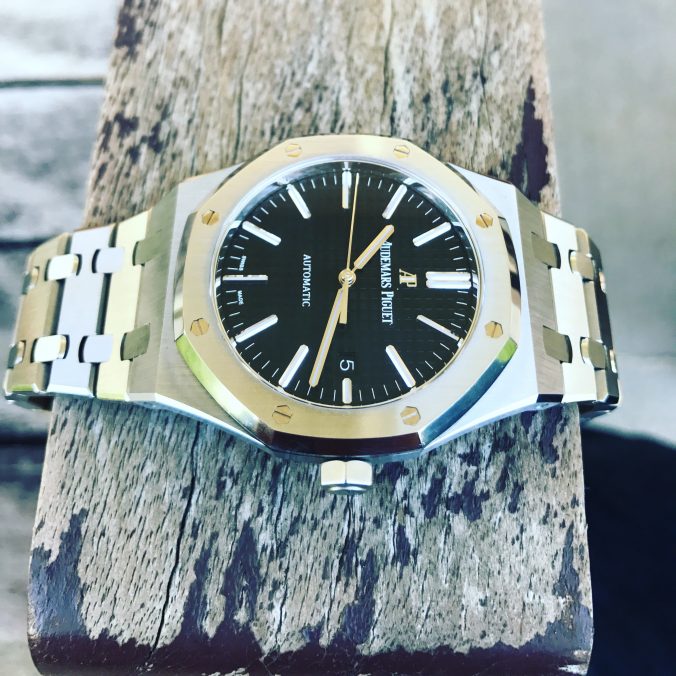
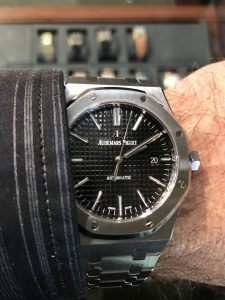
In 1972 an influential watch designer named Gerald Genta, came up with the idea for the Audemars Piguet Royal Oak. The idea was to design a watch that was of the utmost luxury and hand finishing, with all the elements internally and externally of the finest time piece one could make. It would have a revolutionary design with an integrated watch-case and bracelet. Every millimeter of the watch’s exterior would be hand-treated to a degree that surpassed what was available at that time. The movement would be of the finest quality and finishing and the dial would be exquisite. The catch was: it would be made of steel.  And, by the way, the cost would be $3600 in 1972, a price six times the retail of a Rolex Submariner at that time and significantly more expensive than most gold or platinum watches at that time.


Initially, this concept caused an outrage and the Royal Oak did not start off selling very well. To add further context, the quartz watch had been invented and was growing rapidly in popularity especially in Asia. A quartz watch contains a simple circuit board run on a battery that could be rapidly mass-produced for pennies on the dollar compared to Swiss mechanical watches, and a quartz design is more accurate than a mechanical watch that is either manually wound or automatic.  Quartz watches were gaining in popularity and severely cutting into the profits of Swiss watch manufacturers.  If anything,  the Swiss watch companies needed to cut costs and try to compete with the lower priced quartz watch.  This made Audemars Piguet’s release of the Royal Oak even more preposterous.

Nevertheless, Audemars Piguet argued that the time involved and artistic craftsmanship  warranted the high cost.  The difficulty of sculpting steel alloys into an octagonal, multi-layered watch-case connected to an integrated bracelet of such high quality was more involved and took significantly longer than the equivalent time piece employing precious metals like platinum or white and yellow or rose gold alloys.  To this day,  many consider the Royal Oak to contain the most elegant and luxurious watch bracelet in the world.

Looked at from another vantage point, an argument could be made that to shape and sculpt the myriad beveled edges and brushed, satinized, reflective and polished facets out of hardened steel, was to mine, within the concept of steel, a novel jewel that started as a pedestrian metal and was transformed to become a precious metal in its own right by virtue of the inspired artful craftsmanship necessarily involved.


There were design flourishes used for the watch case derived from unique aspects of maritime history.  The design concept of the Royal Oak took its cues from old-fashioned diving helmets utilized by divers from the era of Carl Brashear.  These helmets, made of copper, brass and bronze had large exposed bolts placed to help seal the diver’s mask.   This provided an industrial edge and tool-like appearance to watch.  The name Royal Oak was take from a fleet of pre-dreadnaught battleships built for the Royal Navy in England during the 1890s.   The Royal Oak was a fleet of eight ships hence the octagonal bezel. The appearance of the watch is also reminiscent of a ship’s portal or viewing window.


After a period of disbelief and reluctance to pay what was thought to be an exorbitant price for a ubiquitous alloy, the Royal Oak began to catch on and slowly sales began to increase.   Soon the Shah of Iran became a vocal owner of the Royal Oak. Others in Hollywood and luxury watch   enthusiasts in exclusive circles began wearing the Royal Oak and expressing its novel position in the world of watches and jewelry.

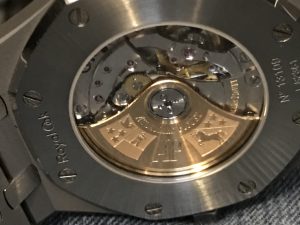
There were components of the watch that were pure gold such as the 22 karat winding rotor seen through the exhibition case back, and white gold screws visible securing the octagonal bezel on the front of the case.


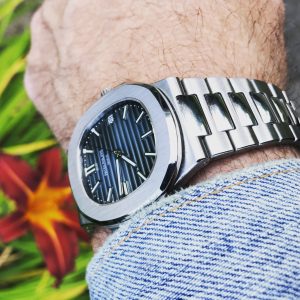
Soon after, Gerald Genta also designed a similar watch in steel for Patel Phillipe called the Nautilus.  The Nautilus also took its inspiration from nautical themes.  The shape of the case is somewhat rectangular with outcroppings on both sides that look very much like ears.   The overall thrust of the Nautilus also feels like a viewing portal from a ship.   One can see that both of these watches share similar DNA and they are the product of a designer who was able to provide a concept that the watch world has embraced wholeheartedly over the course of the last forty years.   Over that course, these time-pieces have earned cult-like status and have become two of the most sought-after watches in the world.  There are now many variations of both the Royal Oak and Nautilus in various gold alloys as well as platinum with a host of other complications, but the steel versions of both still command the highest interest, where in most markets these both sell for well over retail  preowned.


Currently Rolex ha a shortage of their steel sports watches with gold , two-tone and platinum watches being readily available. In the world of vintage sports watches steel consistently fetches higher auction prices than the equivalent pieces in gold and platinum. Companies like Patek Phillipe that manufactures most of their watches in a gold alloy or platinum is finding that the few steel pieces that they made and sold over their history have become insanely valuable compared to their more plentiful precious metal counterparts.


Is a precious metal born or is it made?  Can a watchmaker turn a relatively pedestrian metal into a precious jewel with the artistic craftsmanship, or is steel by definition a common non-precious metal no matter what is done to shape or change it. Is it possible that for certain objects, a sports watch for instance, a certain alloy like steel is preferable in terms of its resistance to stress and its wearability as opposed to softer more malleable and scratch prone alloys like gold and platinum,  and as a result these steel versions appreciate more than gold.  Additionally, there are other metals, not yet as desirable as steel, like titanium, ceramic, carbon fiber, or pure sapphire that are more scarce than steel and have unique qualities, yet are not categorized as “precious metals, ” and are becoming increasingly more popular as a luxury materials.

But who really cares about any of this?  I enjoy the history and it adds texture and context.  A passion for something lives at a remove clouds away from the text conceived to explain it.  So why am I writing this?  Is it possible, with the right words, to turn the material into the sacred, the form of what I hold in my hand into the spiritual with words that otherwise would just be words.  One can aspire to that and I believe it is never achieved but the collateral bits and pieces that exfoliate off the pages during this effort bow to the spiritual.  When something is made by human hands and it becomes timeless,  it is called art.  Something happens that is no longer a lump of bronze, paint on canvas, or 367 tiny parts oiled and intricately aligned accurately to record this human invention within the apparatus of the brain, called time.  When an object is created by Grace pulsing into human hands from a great unknowable reservoir, there is an obligation to admire and respect it.

Art is fickle.  Human beings are fickle.   Vain attempts to understand tarnish more often than not.  Precious arrives in a world of rules, confined by strictures of matter and space and the limiting expressions designed to understand the unknowable.   When I see beauty hemmed-in by the bayonets of  perceived human certainty I imagine an engineer constructing formulas to understand the sunset.   No one else can tell an individual what qualifies as precious.  The Royal Oak, and its subsequent fleet of progressively more elaborate iterations, never lost the minimalist beauty of steel on a three-handed, time-only watch.  When I first saw the Nautilus or Royal Oak bracelet, I had trouble believing that it was steel.  I too did a double take.  And then I felt it.  A liberating sensation in my gut, a visceral explanation of the sublime with a lexicon no one else has to understand, a nomenclature born in the heart and outside of all reason with a new clarity not found in any any book or any writing.  That may be what I perceive as precious.


Rampant Rabid Syphilis

The cracked and cobbled sidewalks

Seams grouted with the tears of lust

The Lower East Side alleyways

Radiate a  body-part stench and smoke from

The burn of  bruising relationships

You can hear the echo of emotions

As the footsteps in unison draw near


All the freaks  soiled with the germ of love

Haunt bars at night like cavalier sex addicts

Looking through stained glass

Searching for that special one

Formed out of the gutter’s blood

Down on avenue A

Where inside the park

The whispering hoodlums triangulate


Aftershocks  before the gentrification project

Old stand-byes open their condemned  cage doors

Punk watering holes in cross section with oiled prison grates

7A and 9B —bars named by cross streets

A palette of gender colors  and drug choices

Men find authentic selves in women

Everyone blends into distraught beauty

Outrage circles back in time corralling bad memories

All gunmetal and diesel stained

Men’s faces as real as tire tracks

Women line up on bar stools

Birds strumming a telephone wire

Asphalt cheeked and bedeviled

There is no fluff or pomp

Accolades rain down like grenades

Sex objects with no power of choice

Music starts like road-kill splatter

Wet Doc Martins trample the dance floor


The punk scratching distorted bass line pummels eardrums like a speed bag

The body gallops to the thudding percussion

Torn shirts with hidden tattoos

Collide with platinum women in stilettos

Maidens pulsate and the floor vibrates

Oblong night glasses reflect the moon’s silver tongue

While  dilated obsidian pupils carve out more night

The catatonic lean on the soft waves of early music

As the frenetic scream back at the bar


There are no take-home lessons

It all happens here

The awestruck certitude of  animal lust

Rules the shy ones cowering in plastic positions

Until they are assaulted and dragged into the dark

The formula is mixed and the barbaric matchmaker laughs


The singer growls out the lyrics

A fever pitch resides at ankle level

Music now mounts the voluptuous crowd’s hind quarters

Steam is kicked up from sweat on the dance floor

He licks the sweat from her brow

She pulls his pelvis onto hers


…and the lyrics go:


— “Bodega girl had a bad case

—of the clap between her legs

—she cried right by her window

—hoping her man would come back”


–“rampant rabid syphilis

–rampant rabid syphilis

–rampant rabid syphilis”


–“oh how she burned up inside

–with 18 year old jealousy

–her man was in another’s  arms

–her snatch way too forgone”


–“rampant rabid syphilis

–rampant rabid syphilis

–rampant rabid syphilis”

The drummer bangs the cymbals with a forceful shiver

The awkward singer bleeds from his lips

Dancers claw onto the stage

Brute bouncers step on hands and keep the crowd submerged

The shapeliest in garters smart as foxes elope to the basement

Where the darkness forges electric steel bondage

The maestros of necrophilia settle for a pulse and warm breasts


Electric sparks leave the stage in  metallic spurts

A down-hop bell-bottomed bourbon whore

Bangs the godsmack into barbed-wire slow motion

Dancing off the drug’s  elements in erect smoke rings

As corsets with gunpowder fill-up the push-up bras

The band penetrates into basement speakers

Lighting the way and the lyrics go….


—“Ooohhh Bodega girl

—you were everything to me

—The sweetest grape on the vine

—Until love poisoned your rose”


—“And Oh Oh On Bodega girl

—How I loved you

—before you were polluted

—now I can’t bear it

—-anymore, anymore, anymore…”


–“rampant rabid syphilis

–rampant rabid syphilis

–rampant rabid syphilis”


The Sane Couple

I sit down inside Starbucks by a great plexiglass window to people watch. I pour half a pint of vodka into my ice coffee. The window gives me access to the people walking on SW 10th Avenue during the lunch hour.   No one looks back at me.  I feel like I am on the other side of a one-way glass that detectives use to break down suspects during an interrogation.

Everyone seems to be walking toward private fears.   I see a morass of integrated humanity, a continuum that, if put to celluloid, could easily absorb a seasoned filmgoer.  A rolodex of caricatures floating by on a wagon toward the big tent performance.  A delicate drizzle coats pedestrians with a warm icing no one cares to notice. Rain does not alter the posture or gait of the walkers in Portland.  No one lowers a head.


The person next to me in the café has a locked-on stare out the window. She is having an absence seizure. The act of following the cadences of gait has hypnotized her.  Following person after person, across the window, with their metronomic gait patterns, has a mesmerizing effect until it seizes her and suddenly she disappears and goes absent. Her eyes stop following the people and sleepily focus on a square of sidewalk. There is an unresponsiveness and catatonia for twenty seconds, then she returns and her eyes resume their incremental lateral to medial gaze as if she is watching tennis. This happens again a few minutes later. Where does she go? She appears unaware of these spells. I imagine holding a charm on a chain, ticking back and forth before her eyes. I could have commanded her into any memory.  Perhaps I could have coaxed her to do anything . For a while I ponder the possibilities, then my thoughts return to the procession.

The pedestrians continue to fill my field of view as the vodka kicks in with a warm mental buzz that gives me an open mind and sense of ease.  I feel an inspired sensation that makes me feel both gauzy and crystal clear. I see things and think thoughts that otherwise would not come to me. The parade is both nostalgic and distinctly modern that even the transvestites have Grace Kelly’s fashion sensibility.   Portland proudly announces itself as a nucleus for the terminally weird and today is no exception.

Just then,  Bluebeard ambles by dressed in baggy pink chinos way too short and a black T-shirt that is swimming on him.  He wears sneakers that are an off-brand replica of “New Balance” running shoes.  His strides are long and deliberate with one leg gathering more ground than the other.  A gait so unique it could be an identifying feature from a great distance, even before you notice the blue beard.

Bluebeard is a character who surfaces on the streets of Portland now and again. He has a beard that extends down to his nipple line and is dyed royal blue. He invariably steals the show when he walks by and even my neighbor now shifts her gaze acutely and with emotion after she notices him

I remember my mother reading me the story of Bluebeard as a child.  It is a fairy tale about a powerful and nefarious lord who marries and kills six of his seven wives.  He is a gruesome and monstrous man but is able to lure women with his great wealth.  He warns each, in turn, not to look behind the door to one of the rooms of his castle.  Each wife is given keys and has permission to view the rest of the castle and every other room without restrictions.  The sense of curiosity is too great for each bride and when we follow his final wife as she looks behind the door, she finds the corpses of the other dead wives.  On a more positive note, his seventh and final wife narrowly escapes Bluebeard’s attempts to kill her and survives.

As I sit and contemplate having just witnessed a modern-day Bluebeard on a lunchtime stroll, I consider the deeper meaning of this tale and the point this strange individual is trying to make by channeling the spirit of this murderous folk symbol.  Certainly, it seems, the story is telling me to temper my curiosity and to be aware of the temptation to explore forbidden areas of life.  But there must be more to it.

I stay on this thought-thread and consider a more psychological theory of this myth.  If the castle is a metaphor for Bluebeard’s mind, then there are rooms and compartments that we expose to the outside world in the form of different aspects of personality or behavior.  Most all of my castle, my personality, is on display for others to see and visit.  There are certain areas of the mind, represented by the one room, that I would never choose to share with another; certain thoughts, ideas, fears or unconscious aspects of the mind that I would not allow anyone to see or visit. The off-limits room could be the unconscious mind in general which can be terrifying in its deep mystery and unpredictable content.  Perhaps it is that part of my mind and thoughts that would drive anyone away if they were to be exposed to it.  The death of the wives is simply another metaphor for the fact that once exposed to Bluebeard’s deepest innermost dark side and demons, they would be unable to tolerate him or coexist with him.

Perhaps our modern-day Bluebeard has had five, six or seven difficult marriages. His tremendous beard dyed in royal blue harkens back to a mysterious and iconic French fairy tale that alerts those around him that he is impossible for women to get along with.  He wears this warning on his sleeve to forestall any possibility of an inchoate relationship. It would be impossible for a woman not to notice this symbolic flourish and in doing so he is expressing a rigorous type of honesty concerning his eligibility in this arena. The possibility also crosses my mind that our friend simply enjoys the color blue and simetimes a cigar is simply a cigar as Freud would say.

Just then my attention is diverted.   A woman walks by holding a magenta parasol and wearing a black dress.   This is curious considering the sun is hidden by the clouds, the rain has stopped, and the utility of this sun-resisting accessory is far outweighed by her sense of outmoded style.   I notice a man emerging from the Governor Hotel and she quickly runs toward him and gives him a one-armed hug and kiss while holding the small umbrella over both of them.  They are a handsome couple. There is a delicious, intimate familiarity to how they touch.  He is dressed as a dandy with a tan fedora and mohair suit with two-tone wingtip shoes.  She has prominent ears, and her eyes survey everything in a way that makes the rest of her bloom.  She walks with a confident stride folding her arm into his.   As he looks straight ahead, she is peculiarly aware of her peripherals to the point where you know her senses do not miss a trick.

Her tight dress hugs her shapely hips and her glossy white legs migrate down to contoured muscular calves that wink above her high heels.   A simple sample or maybe a feast for eyes that have hackneyed entanglements, she attracts a sane partner with a forever gaze that burns during these moments before a full exposure occurs and the undress of the soul reveals all that temps and all that corrodes.   She carefully avoids the stereotype of torn jeans and tattoos, while her falsetto yearns above all operatic scales.  After the scene and the sane couple return home, she vanishes back into the girl she is, never wondering what men really think.

I stand up and notice my neighbor is now reading a newspaper.  I feel a little light-headed but it is not unpleasant.  I drain the rest of my ice coffee and drop the cup in the wastebasket.  I throw my shoulder bag on and walk back to work.


What Makes Me Laugh?

If I were asked to describe what makes me laugh, I would have to pause and think for some time about the question. It is like asking me to tell a joke, on the spot.  I possess so many jokes and funny stories residing just below the resolution of my consciousness that to revive them I require a reminder to jar the memory loose.  My guess is that I do not deal in jokes as a currency for building relationships with others and as a result, I usually forget jokes despite having been told thousands of them during my lifetime.

I can, however, describe the broad strokes of genre and category that tend to bring me to laughter.  This would include: slapstick and deadpan comedy, gallows humor as well as interestingly incongruous occurrences that clearly do not belong in the context of when they appeared. I enjoy any kind of behavior (it could be a human or derived from a dog, any being or robotic entity) that is inappropriate for the situation or simply eccentric in many respects. Sometimes the mere sight of certain visual stimuli without warning can be funny to me especially if what I am observing simply looks funny or reminds me of a previous comedic incident. I like to think of laughter as an emotion that, if it is true, happens by accident and as a complete surprise to the recipient.  Anything that is contrived and designed in a premeditated way only to elicit laughter is most often not funny at all and does not usually provoke a laugh in me.

There are certain  comedians whose eccentric behavior is so bizarre that commonplace activities become funny.  These actors play characters who are oblivious to their eccentricities and they interact with others in a fashion where these comedians perceive their behavior as commonplace.  Each person exposed to them is  silently perplexed with their over-the-top antics and even the smallest statements or gestures can be sidesplitting.  Tracy Morgan and Zack Galifianakis  are classic examples of this type of humor as well as Adam Driver’s character Clyde, with the prosthetic arm, in “Logan Lucky.”

Ever since I was a small child I was prone to being amused by slapstick. I believe I inherited this characteristic from my father who would become overwhelmed by laughter during an episode of “Laughin’,” or a Marx Brothers film.  W.C Fields as well as Abbot and Costello with their synthesis of word play and physical comedy concocted just the right recipe for keeping my Dad tickled and amused for hours.

My first memories of this include a stunt, often repeated on the children’s show “the Electric Company,’ a “Sesame Street” sister program shown on television in the early 1970’s, on the public broadcasting network and starring a young Morgan Freeman. Included in every episode, out of nowhere, the television screen would fill with a man in a chef’s uniform standing at the top of a steep staircase. He would be holding a large tray stacked high with numerous pies, cakes and elaborately decorated creamed desserts.  As he prepared to ambulate forward, with no idea that a flight of stairs lay before him, and with these desserts stacked so high he could not see in front of himself at all, this man in the large puffy white chef’s hat would vocalize loudly and exactly what he was carrying.  For example, he would articulate in a l booming voice: “thirty-seven banana cream pies!”

After this proclamation, he steadied himself and took a step forward only to be hilariously surprised that there was a drop-off of multiple stairs, resulting in a dramatic, forward-tumbling pratfall down the steps that was a study in messy, acrobatic artistry.  Pies and creamed goods flew in all directions including into the baker’s face as he cascaded and caromed down the staircase in spectacular fashion.  His fall was made all the funnier by his obvious gifts of agility and supreme balance, which were comedically transformed into fabricated catastrophic clumsiness.  Improvised clumsiness by an athletic actor is a signature of great slapstick and it goes back to the era of silent films.

The stuntman who performed this debacle, was capable of taking an inordinately long time to draw out each phase of his fall.  This beautifully perfected stumble progressed as if it were in slow motion. Pies catapulted away from the main scene and into the faces of nearby, well-dressed, and high-heeled woman who happened to be sauntering by.   Members of the audience, who were quite a distance away, also received face-fulls and gobs of lathering cream as lightweight aluminum tins were somehow launched incredible stretches of space into the back rows during this miraculous pratfall.

Other desserts landed on the stairs perfected positioned like landmines in the baker’s path only to cause secondary slips and paroxysms on the slick frosting and slippery white fluff, while he continued to ricochet down in postures of partial recovery followed by a somrsaults.   The prolonged fall was truly inspired by a great genius of advanced stage mishap where the victim never felt a bruise or incurred a single musculoskeletal injury .   It all came to a thundering conclusion with a perfect landing on his buttocks only to have a pie, thrown up just seconds before, land perfectly on his head.

The entire episode was similar, yet strikingly opposed, to Buster Keaton skipping from rolling log to log on a lake dressed in his Sunday suit with patent leather shoes while carrying a young maiden, threatening to fall with a splash, yet effortlessly mastering these mobile stepping stones all the way to the shoreline.   These off-balance antics would immediately send me, into uncontrollable laughter, while at the same time, prompting my mind to internally bow in wonder at the supreme cat-like agility necessary to pull off these stunts.  Again,  improvised and fabricated  clumsiness rules the day.

Laughter comes spontaneously to me and is stimulated by unexpected sources. Suddenly seeing an English bulldog in a restaurant, for example.   I tend to laugh more when an out of the blue incident occurs completely surprising my funny bone.  A unicyclist rides down the center of SW 10th avenue in Portland while I am sitting and people-watching.  Contrived comedy, by a comedian or a staged set piece designed to elicit laughter as its only purpose usually fails to initiate laughter in me.  An exception would be staged set-pieces involving well-thought-out slapstick elements. Most situation comedies on television with laugh tracks I find completely unfunny. Many films categorized specifically into the comedy genre are not funny in my opinion.

There are moments, in serious films, even sad films that carry situations so unthinkable to the plot at hand, yet somehow perversely pertinent to a point where laughter feels wrong but is unavoidable. I find this scenario funny.   It may only be the selection of a song whose lyrics add dark humor to the story. There can also be a character whose voice or delivery is so eccentric, yet real, that anytime that person speaks I cannot help but laugh. I think of Adam Driver in the film “Logan Lucky.’’ Another example from the same film is when Adam Driver’s character Clyde is helping to steal money by transferring it from the collection depot at the NASCAR stadium to another site by suction inter-tube system, and in the process his prosthetic arm is suddenly sucked into the tube system. This is hilarious on many levels.

The film “Broken Flowers,” directed by Jim Jarmusch and starring Bill Murray, has moments where Bill Murray is either unexpectedly assaulted or is left with a mortified look on his face. These situations elicit a joyful response in me. These moments and expressions of humor can be categorized as “deadpan.” I am a serious fan of deadpan humor. Jim Jarmusch, throughout his career as a director of films, utilizes deadpan moments with poetic grace and sublime subtlety. One of his favorite motifs in film is to have characters from different cultures who speak different languages, interface in English.   The resultant misunderstandings that lead to puns and wordplays or simply cultural variations in the definitions of similar words provokes  hilarious, “lost in translation,” consequences.

Humor is an intensely personal sensibility.  What was funny in the 1970’s may not be funny today.  Mel Brooks seems dated when I watch him now, and some humor devised today I may dislike simply  because a simply am not privy to some of the inside jokes of this generation.


Newer posts »

© 2026 Curiously Colorito

Theme by Anders Noren — Up ↑